Best oasdiff Alternatives in 2026
 Sébastien Conejo
10 min read
Sébastien Conejo
10 min read
You may be looking for an oasdiff alternative for all sorts of reasons. oasdiff compares two versions of your OpenAPI spec inside your pull request, flags the breaking changes and fails the check. If you publish an API, it does the job.
Many teams searching for an oasdiff alternative run a setup with a long list of connectors: Stripe, Twilio, Shopify, a dozen partner APIs and their own internal services. oasdiff is built mainly for the vendors who publish those APIs. It can also watch a third-party API, but only when the provider publishes an OpenAPI spec and keeps it current, and many providers don’t. For these teams, oasdiff may not be enough.
This list has two groups. The first does oasdiff’s job and protects your consumers. The second does the opposite job and protects you from the APIs you consume, and it barely existed a year ago.
| Tool | Built for | What it watches | What it produces | Pricing |
|---|---|---|---|---|
| FlareCanary | API consumers | Live third-party endpoints | Drift alerts | Free (5 endpoints), from $19/mo |
| Manifest API Bot | API consumers | The APIs your repo calls | Pull requests with the fix | Free |
| APIShift | API consumers | Live third-party endpoints | Drift alerts | Free (5 APIs), from $29/mo |
| DeprecationWatch | API consumers | Changelogs, deprecation pages, Sunset headers |
CLI alerts, CI failures | Free, open source |
| SpecShield | API vendors | Your OpenAPI spec | PR checks, deploy gate | Free tier, $89/mo |
| Bump.sh | API vendors | Your OpenAPI, AsyncAPI or Arazzo definition | Docs and changelog | From $50/mo |
| Spectral | API vendors | Your OpenAPI spec | Style and design rule violations | Free, open source |
| Pact and PactFlow | API vendors and consumers | Contracts between your API and its consumers | Contract test results | Pact free, PactFlow free tier, paid from about $115/mo |
| openapi-diff | API vendors | Two versions of your OpenAPI spec | Diff report, CI failure | Free, open source |
| CodeRifts | API vendors | Your OpenAPI spec in each PR | Risk score and verdict | Free, Team $149/mo (free during beta) |
| TypeMorph | API consumers | A saved response, compared in your CI | Schema diffs | Free |
| Unified APIs (Merge, Apideck, Nango…) | API consumers, via a unified layer | The APIs they support | A managed layer | Varies by vendor |
An API vendor publishes an API that other teams call: Stripe publishing its payments API, for example. An API consumer is an app that calls APIs, other companies’ or its own: a SaaS that calls Stripe, HubSpot and its own billing service.
1. FlareCanary

FlareCanary is the closest thing to oasdiff for the APIs you call that publish no spec. You point it at an endpoint you depend on, with auth headers if needed. It polls on a schedule, captures the response schema as a baseline and alerts you when the shape drifts, with a severity on each alert. It needs no OpenAPI spec, which matters because many third-party APIs don’t give you a current one. It also watches the tool schemas of MCP servers, which is new.
FlareCanary launched in early 2026. It’s free for 5 endpoints checked daily and costs $19/mo for 25 endpoints checked hourly. A REST API lets you wire it into your CI or deployment pipeline, and it has no self-hosting yet.
Best for: teams that want a canary on a handful of critical third-party endpoints, today, in five minutes.
2. Manifest API Bot

Drift detection tells you that something changed, and the next job is finding the affected code and fixing it. API Bot is built for that part.
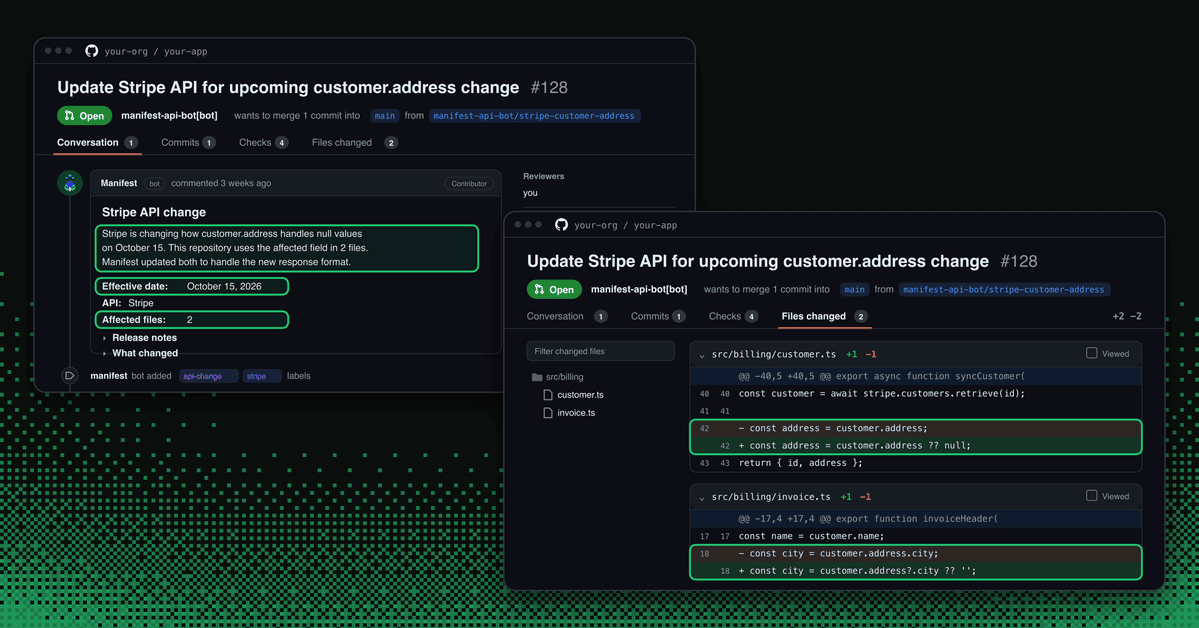
You connect your GitHub repo, and API Bot finds the third-party APIs your code depends on without you listing them. It checks them daily. When a change affects your code, it opens a pull request with the fix already written and the context attached: the API, what changed, when it takes effect and which files it touches. Your team reviews it like any other PR. If a provider announces that a field goes null on October 15, the PR is waiting before October 15.
API Bot is built for teams with a long list of connectors. Your app may call Stripe, HubSpot, a partner API and your own internal services, and API Bot covers all of them, so your team can review and merge the fix before the breaking change reaches production. It also works alongside the code reviewers you may already run, like cubic or CodeRabbit: they read your diff, and API Bot watches the APIs your code calls.
Best for: teams whose real cost is the engineer-days spent fixing an API change once they know about it.
3. APIShift

APIShift works like FlareCanary: it monitors external endpoints live and grades each schema drift LOW, MEDIUM, HIGH or CRITICAL. It checks every 5 minutes on the $29 tier and in real time on the $99 unlimited tier.
Best for: teams that want high-frequency checks across many APIs without an enterprise budget.
4. DeprecationWatch
DeprecationWatch is an open-source Python tool for the changes a provider announces. You declare the APIs your project uses in a YAML file, and it watches their changelogs, deprecation pages and HTTP Deprecation and Sunset headers, then alerts you 90, 30 and 7 days before removal or fails your CI with --fail-on breaking. It won’t catch an undocumented change, but for announced deprecations it’s the cheapest early warning there is.
Best for: teams that want deprecation tracking in CI with no SaaS involved.
5. SpecShield

SpecShield is the first tool on the list that does oasdiff’s actual job. It diffs your OpenAPI spec for breaking changes like oasdiff does, and its author says oasdiff is still better at raw detection. SpecShield adds what happens after the diff: a can-i-deploy gate that consumers register against, hosted PR checks, team history, an IntelliJ plugin and an MCP server, so a coding agent can run the gate before opening a PR. The analysis is fully deterministic, with no LLM involved.
SpecShield has a free tier and costs $89/mo for teams.
Best for: API publishers who want oasdiff’s checks plus a deploy gate, without adopting Pact.
6. Bump.sh

Bump.sh starts from the documentation. You push your OpenAPI, AsyncAPI or Arazzo definition, and Bump.sh hosts the docs and generates the changelog between versions, with breaking changes highlighted. It’s how a provider tells its consumers what changed. FlareCanary sits on the consumer’s side, and Bump.sh on the provider’s.
It costs $50/mo for 10 docs, and $120/mo for 30 docs with the automatic changelog included.
Best for: API publishers whose consumers keep asking “what changed?”.
7. Unified APIs: Merge, Apideck, Knit, Nango


Unified APIs answer the same problem from the other side: they put a layer in front of the APIs, where the tools above watch them from outside. Merge and Apideck give you one common schema per category and absorb each provider’s changes behind it. Their categories include HRIS, CRM and accounting. Nango works differently: you define your own schema, and you or a coding agent write the mapping for each provider, across 1,000+ APIs in 30 categories.
If your integrations fit what a platform covers, the layer takes most breaking changes off your plate. Nango still recommends runtime validation and logs to catch breakage in custom code. Two things are worth checking before you commit. The first is coverage: a platform covers some categories well, and teams often keep hand-written connectors for the rest, which are the ones that break. The second is cost. Apideck charges per active customer, and Nango charges for a mix of connections, compute and data transfer, so the break-even depends on how many customers and connections you have. If your integrations span categories that no single platform covers, the platforms add up, and you still need a plan for the long tail.
Best for: teams whose integrations sit in categories a platform covers completely.
Other tools you’ll see in searches
Four more tools come up when you search for oasdiff alternatives, and all four work on contracts or specs.
Spectral is Stoplight’s open-source linter. It checks your OpenAPI spec against style and design rules, and it doesn’t compare two versions of it.
Pact and PactFlow test the contract between your API and the services that call it. Consumers write the contracts, and PactFlow’s bi-directional mode compares them with your OpenAPI spec.
openapi-diff is the lightweight classic from OpenAPITools. It compares two specs and can fail your build when a change breaks backward compatibility.
CodeRifts rates the risk of each OpenAPI change in a pull request, on GitHub, GitLab, Bitbucket or any CI, and returns a verdict: allow, warn, require approval or block.
One more is built for API consumers. TypeMorph is first a JSON to TypeScript and Zod converter. It also infers a schema from a JSON response you save as a baseline, then flags breaking changes when a new response differs, with no OpenAPI spec. You run it in your CI, or paste both responses into its free web tool.
A note on Optic
Optic was the YC-backed open-source tool that owned this space. Optic joined Atlassian in 2024, and the repository was archived in January 2026. oasdiff is the closest replacement for what it did: comparing two versions of a spec in CI.
Which one, when
If you publish an API and want CI guardrails, stay on oasdiff. Add SpecShield if you need a deploy gate, and Bump.sh if you need to communicate changes.
If you consume APIs and want to know when they move, use oasdiff when the provider publishes a maintained spec, and FlareCanary or APIShift for live drift when it doesn’t. Add DeprecationWatch for announced deprecations. Pick by how many endpoints you watch and how often.
If you consume APIs and want the fix itself, use API Bot. It’s the only tool here that opens the pull request.
If your integrations fit what a platform covers, use a unified API, with the two caveats above.
FAQ
Is oasdiff for API providers or API consumers? It’s for providers first. It compares two versions of your own spec in your own PR. It can also watch a third-party API when the provider publishes an OpenAPI spec and keeps it current.
What’s the closest oasdiff equivalent for third-party APIs? For third-party APIs with no maintained OpenAPI spec, FlareCanary and APIShift come closest for alerts. For a fix delivered as a pull request, Manifest API Bot does.
Do I need an OpenAPI spec for these?
For oasdiff and SpecShield, yes. Bump.sh needs an OpenAPI, AsyncAPI or Arazzo definition. FlareCanary, APIShift, TypeMorph and API Bot work without one. DeprecationWatch needs the provider to publish something it can read: a changelog, a deprecation page or Sunset headers.
Can I use oasdiff and one of these together? That’s the normal setup: oasdiff in CI for your API and for any provider that publishes a spec, and one of the consumer-side tools for the rest.