The AI Agent API Reliability Stack, September 2026
 Team Manifest
5 min read
Team Manifest
5 min read
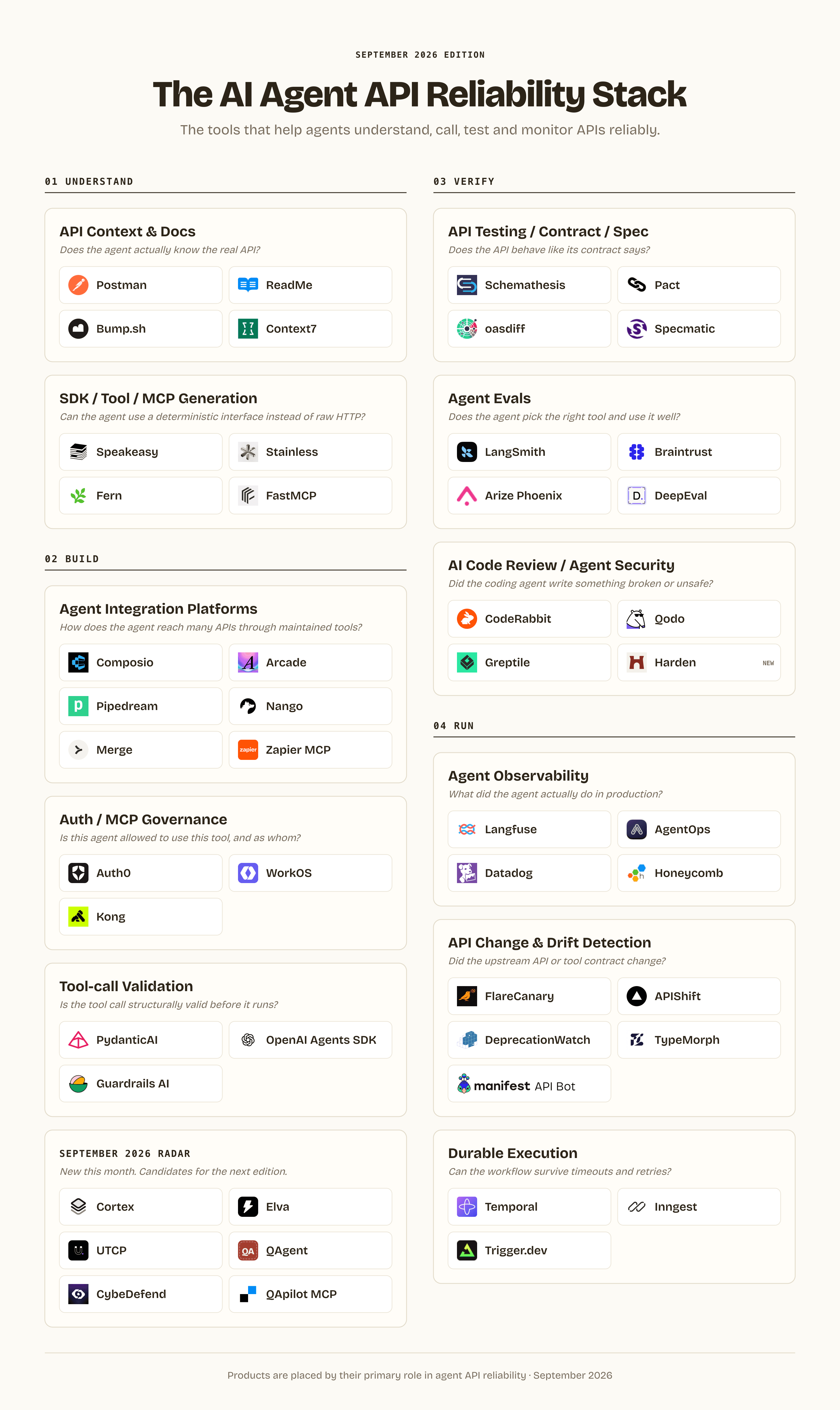
We want agents to take actions through APIs: create the invoice, update the CRM, open the ticket. Handing the model a tool and hoping is how most teams start, and it breaks in many different places. We went looking for what exists for each of those places, and kept finding products that each solved one piece of the same chain.
Two real cases we looked at closely while doing this. An open-source agent project sent max_tokens to OpenAI’s chat completions, which gpt-5, gpt-5-mini and o4-mini now reject with a 400, so its fallback failed on every call as soon as a user picked one of those models. A research app’s literature search stopped at 9,999 results without an error, because the provider’s API can’t page past that, and its journal lookup called an endpoint that no longer exists, so it always came back empty. Nothing in either codebase looked wrong, and each problem needed a different kind of fix.
We went through a bit over 100 products and cut the map down to 44. Four stages came out of it on their own: Understand, Build, Verify and Run.
How to read it
Understand. The agent needs an accurate picture of the API: docs, current specs and context for coding agents. The generation tools belong here too, because the cheapest way to avoid a bad request is to stop making the model improvise raw HTTP.
Build. The agent needs usable actions: integration platforms with maintained tool catalogs, auth, permissions and governance, plus validation of tool arguments before they run.
Verify. You verify two different things. First, does the integration respect the API contract? That’s Schemathesis, Pact, oasdiff and Specmatic. Second, does the agent behave? It has to pick the right tool and call it with the right arguments in the right order, and that’s what agent evals check. Coding agents add a third failure point, which is why AI code review and agent security are in this stage.
Run. In production you need to see what the agent did, detect when an API or tool contract changes, and keep long workflows alive. Durable execution (Temporal, Inngest, Trigger.dev) keeps a workflow alive through timeouts and retries, but it can’t turn a wrong request into a right one. Change detection solves a separate problem: the external contract moved.
That’s also why CodeRabbit, Composio, LangSmith, Kong, oasdiff and Temporal share one image. Each one covers a different point where things fail between “the agent wants to do X” and “the right API call happened”, and none of them competes with another.
What we found most interesting
The interface between agents and APIs is becoming its own layer. The old path was model → raw request. The path we kept seeing is model → typed, curated tool → integration infrastructure → API. Composio, Arcade, Merge, Nango and Pipedream do quite different things, and MCP tooling and SDK generators feed the same layer from the API side. What they share is the position in the middle.
Tool correctness is a separate evaluation problem. Classic LLM evals asked whether the answer was good. With agents you also ask whether it chose the right tool, built the arguments correctly, called things in order, and whether the action matched what the user meant. So eval tools belong on an API reliability map even though none of them tests an API.
Coding-agent reliability and runtime-agent reliability happen at different moments. A coding agent goes docs → specs → generated interfaces → implementation → contract tests → code review. A runtime agent goes tools → auth → validation → execution → observability → change detection. A few products span both. Most live in one, which is why CodeRabbit and Composio sit on the same map without overlapping.
A correct integration can become incorrect later. The docs were right, the schema validated, the tests, the evals and the review all passed. Then the provider changes an endpoint, deprecates a field, alters a response shape or edits a tool contract. Nothing in the repo changed, and it’s still broken. That’s why change and drift detection sits at the production end of the map.
Method
The map is an editorial selection, and it doesn’t try to list everything. Each product sits in its primary role, and several could go in two boxes. General-purpose LLMs and IDEs are out. Some good products are missing only because another one already showed the same approach. The map is a September 2026 snapshot, and the Radar box lists newer products that launched or showed a fresh signal that month.
Why we made this map
The last finding is the one we work on. Manifest API Bot watches the third-party APIs your repo calls, scans it once a day, and opens a pull request when one of them breaks your code. It’s free for early adopters and installs in one click. The 9,999-results case above is the kind of thing it exists to catch. If you’d rather be the team whose integrations don’t break on a Monday morning, get started now.